Vet fees up to £15,000
To suit your pet’s needs, choose vet fee cover from £1,000 to £15,000. The limit resets every year you renew.
Design your own pet insurance
Policies as unique as your pet. Set your own limits, excess and optional extras, for cover as snug as a collar.
Switch with unbroken cover
If you switch to us from a like-for-like policy, there’ll be no gap in cover, with protection starting straight away**.
Content by Dr Siân Burwood MA VetMB MRCVS
Skin allergies are where an overactive immune system in your dog causes release of chemicals that makes their skin itchy. As your dog scratches, rubs and licks the affected skin, further substances are released causing a vicious cycle of itching, pain and damage to the skin.
Secondary infections are more likely in the damaged skin, and in the long term the skin becomes scarred and thickened.
Skin allergies are seen increasingly commonly in dogs. While not fatal, they can cause real suffering for both dogs and their owners.
Skin allergies happen when the body detects an allergen – something that the immune system does not recognise as itself – but then has an overreaction to it.
Every dog has an ‘itch threshold’ above which they start to itch. For allergic dogs this is really low, so levels of allergens that wouldn’t affect a normal dog can cause serious problems. Not every allergic dog is allergic to the same thing (or things), or to the same degree.
Allergens are typically:
Proteins – especially chicken, lamb, beef, pork and dairy – are usually the culprit in food allergies. Gluten and grains are often blamed by dog owners, but are very rarely the cause of problems.
Dogs don’t experience hay fever in the same way humans do. But flowering of certain trees, bushes and grasses can release pollen allergens.
Every home, no matter how clean, is full of house dust mites. And along with various food storage mites, these can all be causes of allergy for our dogs. Sensitive dogs are also more likely to react to harsh or strong-smelling cleaning products (like Shake n’ Vac), candles and diffusers.
Some dogs suffer from atopic dermatitis or atopy. This describes where the immune system itself doesn’t work properly, rather than just being allergic to a specific thing. These cases are almost impossible to distinguish, however, because these dogs react to pretty much everything.

Although any dog can be affected by allergic skin disease, genetics play a very important role. We know that certain breeds and lines are more affected than others. These include:
Affected dogs should never be bred from, as they’re likely to produce affected puppies.
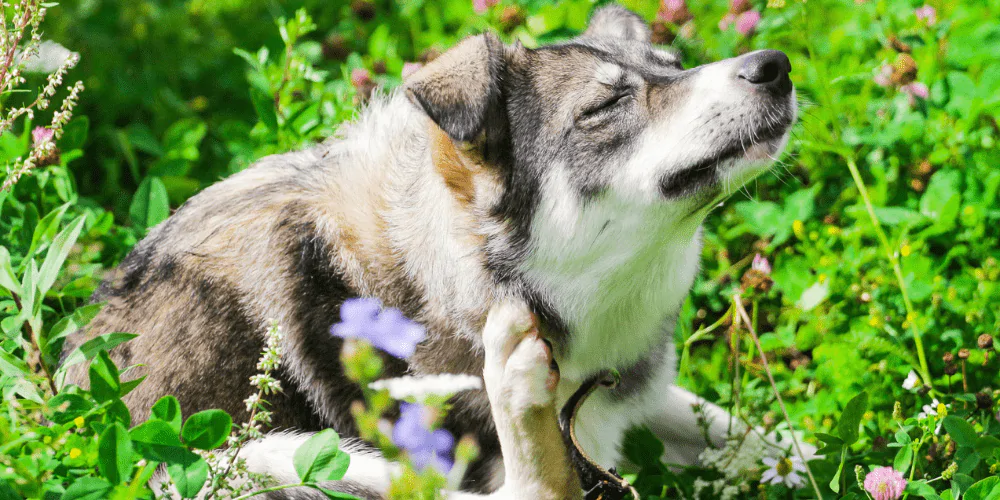
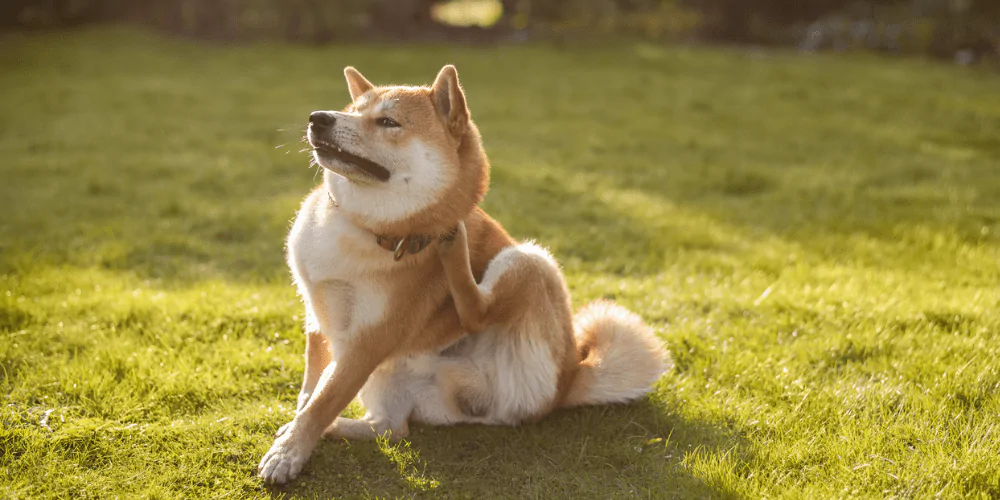
Mild skin allergies often present as dogs who will lick their paws more than you might expect and seem to be obsessed with foot washing. They may also use their paws to rub their face, and might rub their body against the furniture or roll around on their backs.
Their skin may always seem a little bit pink, and you might see patches of reddy-brown saliva staining on their fur – especially if it’s white!
For some dogs, the only sign of allergic skin disease you might see is recurrent ear infections.
In milder cases, history and signs are often enough to make you and your vet suspicious of allergies. You may already have realised that they seem more itchy after certain foods, for example. Swabs of any ear or skin infections may be needed to see what secondary bacteria are involved.
Your vet is also likely to advise some common-sense options to help them logically rule out the most likely causes, including:
Diagnosis and treatment of skin allergies must be logical and done as a team with your vet. It’s tempting to try all sorts of home and over-the-counter remedies first, but it can end up just being more confusing!
Treatment will involve:
Sometimes medications are needed in the short term to break the itch-scratch cycle.
Allergies can never be cured, but can be managed. In mild to moderate cases, once inflammation and itch is under control, use the treatments listed above and work together with your vet. Then your dog should be able to lead a happy life – either off or with only occasional medication.
Severe skin allergies can cause really distressing symptoms, and often from a young age. Affected dogs seem to be itchy more often than they are not, and often will not rest or sleep so they can scratch.
Their skin becomes very red, sometimes dry or sometimes greasy, with a strong musty smell. It may become flaky, or develop sticky oozy discharges as infections develop. Fur becomes thin and patchy in the places where the dog nibbles – especially over tops of the feet and base of the tail. They often have severe ear infections with lots of discharge and pain.
If these symptoms aren’t treated to get under control quickly, or if they are left to grumble for a long time, then secondary skin changes happen that cannot be reversed. Skin becomes thickened and leathery, often very dry, with darkened pigment. Fur may never grow back. Many aggressive dogs seen in practice are actually just suffering dogs with sore skin.
In more severe cases, in addition to history and symptoms, identifying exactly what the allergy is to can be helpful. Your vet may recommend blood tests to look for antibody levels against certain allergens. These tests may not always be accurate (exposure versus allergy can be hard to distinguish) and are not exhaustive.
Your vet may also want to refer you to a dermatologist in extreme cases.
Treatment of severe skin allergies involves everything listed for more mild allergies (see above), but is also likely to involve more medication. Medications used to treat skin allergies include:
Steroids are usually the cheapest option, but are associated with a range of side effects. The other options have fewer side effects, but are more expensive. Your dog may need more than one of these drugs at different times, or need more as the years go by.
It is very useful for severely allergic dogs to be fed a ‘hydrolysed’ diet – a prescription diet where the proteins within it are treated in such a way that the body cannot recognise them to then overact to them. They need to be fed this and absolutely nothing else for it to work.
Allergies can never be cured, but by working together with your vet and being consistent about management, dogs can have a good quality of life of normal length.
When management is inconsistent and advice not followed, you’ll be at the vets more often. This means dealing with larger bills, as your vet has to get on top of all the secondary issues before they can start treating the underlying problem.
“I spend the majority of my life in general practice dealing with skin allergies in varying degrees of seriousness, and it can be a real welfare problem when not dealt with properly.
“I’d really encourage all caregivers to work as a team with their vet, because when this happens, you can get a happy dog who only needs to see you every 6 months or so. I have seen some of the most extreme cases, who need lots of medication, still be a perfectly happy dog with a lovely coat, because their owners are dedicated and consistent.
“The tricky cases are the ones where owners don’t return for rechecks because they feel the dog is better, but are then annoyed when it comes back. I have to go back to square one for these, treating the infections and the basics before I can even get to sorting ongoing management.”
Dr Siân Burwood, MA VetMB MRCVS
If you’re weighing up a Petgevity Lifetime Plus policy, we’ll consider all conditions when offering cover for your dog*.
When you apply for dog insurance, just let us know:
Find out more about Petgevity’s dog insurance for pre-existing medical conditions.
Choosing Petgevity to protect your pets gives you more than just vet fee cover. Here's what you get from our policy.
Dental accident
Covers your pet up to the chosen vet fee limit if they have a dental accident or injury. Always be sure to take your pet for annual dental check-ups, and follow your vet’s advice.
Behavioural treatment
Get expert help with your pet’s mental and emotional wellbeing, as advised by your vet. Cover up to your chosen vet fee amount or the cost of up to 12 sessions, whichever is lower (Lifetime Plus); or up to £1,000 (Lifetime).
Complementary therapy
As advised by your vet, this covers alternative treatments like acupuncture or hydrotherapy. Cover up to your chosen vet fee amount (Lifetime Plus); or up to chosen vet fee amount or £1,500, whichever is lower (Lifetime).
Emergency care
If you can’t look after your pet due to an emergency, such as an unplanned hospital visit, this covers you for up to £1,500 (Lifetime Plus) in minding costs.
Third-party liability for dogs
Covers you for legal costs if your dog causes injury to somebody or their pet, or causes loss or damage to someone’s property. Protects you for up to £2 million in a legal action.
Choice of optional extras
Need extra protection? Choose from several optional extras to cover your pet’s needs, including dental illness, or cover if your pet is stolen or lost.
Defaqto 5 star rating when you choose vet fees over £4,000 with all optional add-ons included.
Basic cover alone has 3 star rating
Three-time winner National Insurance Awards Pet Insurance Award 2022, 2023 & 2024.
Awarded Best Pet Insurance Provider at The Money Mentor Awards 2024
†For Lifetime Plus policies only – details correct as of 10 September 2024 via competitor websites. Competitor products are subject to their own T&Cs and can have different limits and requirements for cats versus dogs at different ages. For full details, please check the relevant policy wording. For full details of Petgevity pet insurance, please read our policy wording.
Skin allergies are caused by a dog’s immune system overreacting to the allergens they’re exposed to. These can be food, inside the house (like mites and cleaning products) or outside the house (like trees, grasses and weeds) – but can also be caused by a defective immune system (atopic dermatitis).
Yes, skin allergies are lifelong conditions. This is because they’re to do with the dog’s immune system function rather than an infection. While allergies cannot be cured, they can be managed well to give a dog a normal life.
Managing diet is very important for treating any skin allergy, and in some cases can be enough on its own to ‘fix’ the problem. Proteins in food are the cause of allergies, and so using a novel protein (such as in hypoallergenic diets) or a prescription hydrolysed diet can make a significant difference.
Raw food diets are not advised for skin allergies, as the high protein levels actually make things worse (among other concerns).
Yes, allergic skin disease – including food allergies – are common causes of recurrent ear infections in dogs.
Allergies cause skin itching and inflammation, and the ears are a prime site for this causing a problem. If you suspect this, speak to your vet to work out a sensible plan to work out the underlying cause, as it can be very frustrating to do on your own.
Any breed can have allergic skin disease, but genetics are important and certain breeds are definitely more prone. These include West Highland White Terriers, Bulldogs of all kinds, Shar Peis and Pugs.
Yes, ear infections are very common with skin allergies. In some cases, they may be the only sign of a problem! This is because the skin inside the ear is the same as all over the body – but rolled into a tube where it gets warm and moist. This makes overgrowth of bugs more likely. Allergies can cause long-term damage to the ears if left untreated.
†Lifetime Plus policies only
*Cover for pre-existing medical conditions is subject to acceptance. They will not be covered unless you have declared them and they are shown on your Confirmation of Cover.
**Illnesses and symptoms won’t be covered in the first 14 days and accidents won’t be covered in the first 2 days of the policy. This is unless you are switching from another lifetime pet insurance product with no break in cover and the claim you want to make would have been covered by your previous policy. Other exclusions may apply to other sections.