
Guide to spaying your dog
Here’s what you need to know about neutering your female dog, plus potential impact on her behaviour.

Philippa Short
26 February 2026
| 7 minutes read
Whether to spay your dog is a big decision, and not one which pet parents should take lightly. Not least because the timing of your dog’s neutering can potentially have a big effect on their behaviour in future.
Note that spaying and neutering are classed as preventative care. This means you generally won’t be able to claim for spaying on your dog insurance policy. If you need help with the cost of spaying, look into schemes offered by some dog charities.
To help decide what’s best for your dog, we’ve consulted expert dog behaviourist Philippa Short to find out the main considerations. Plus we’ve outlined the steps to go through leading up to the operation, what happens on the spaying day itself, and what to expect afterwards.
- What is female dog neutering?
- What are my options for spaying my dog?
> How much does it cost to spay a dog in the UK? - Dog neutering aftercare
> How long does it take for a dog to recover from being spayed? - Should I get my female dog neutered?
> Will spaying calm a female dog? - At what age should a female dog be spayed?
> At what time in their cycle should a female dog be spayed?
> What behavioural problems are caused by spaying at the wrong time?

What is neutering in female dogs?
Neutering is the surgical removal of some or all of an animal’s reproductive organs. This is known as spaying in females (it’s castration in males). It’s a veterinary procedure typically carried out while the dog is fairly young.
The main goal is to stop them from reproducing, although there are some other potential health benefits to getting your dog neutered. For example, it can reduce the risk of certain infections and cancers developing.
How can my female dog be spayed?
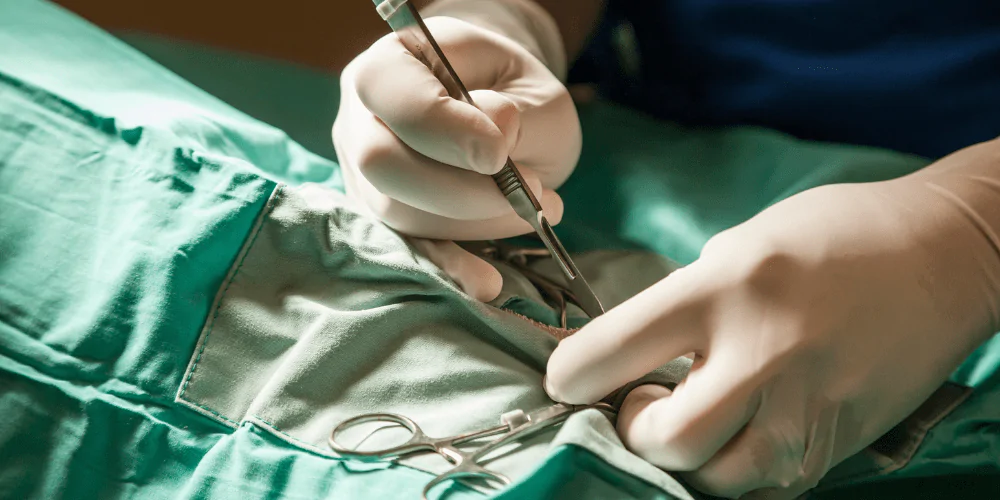
There are three ways in which you can get your female dog spayed, all of which require surgery:
- Removing the ovaries while leaving the uterus
- Removing the uterus while leaving the ovaries
- Taking away both the uterus and ovaries (a full ovariohysterectomy)
Should I get my female dog spayed?
This is really a question for you. Every dog’s an individual, and your choice to spay (or not to spay) will come down to your exact circumstances.
There are several factors to consider before you decide. These include things like your dog’s breed and health, plus your home environment. Ask yourself:
- Are there any non-neutered male dogs in your home?
- Could other male dogs get into your garden, including over the fence?
- Do you have somewhere you can walk and exercise your female dog where she won’t meet other male dogs?
- Is there a higher risk of reacting adversely to anaesthetics in your dog’s breed? (If you don’t know, ask your vet)
- How severe are your dog’s phantom pregnancy symptoms?
There are also potential benefits to weigh up:
- Stopping your dog from potentially getting pregnant
- Preventing her from getting phantom pregnancies
- Reducing the risk of her getting a serious womb infection (pyometra) later in life
- Slightly lowering the risk of her getting a mammary tumour
Will spaying my dog calm her down?
Generally speaking, dog behaviourists recommend spaying if a female dog displays increased aggression and reactivity around the time of their season.
Aside from this, spaying won’t typically improve negative behaviour. And it can make things worse under certain circumstances, for example:
- If she’s always highly reactive, regardless of where she is in her heat cycle
- If she acts like a male, such as frequent urine marking, or cocking her leg
- If she shows confident aggression
If your dog is underconfident or fearful in certain situations (such as with people, being handled or in public places), it’s best to turn to behaviour modification first. This should help reduce their fearfulness.
If you still want to get her spayed, let her have a few seasons, and try to bring up her confidence with being handled. Then return to spaying when she’s ready. If in doubt, talk to your vet about this.
In the UK, how much does it cost to spay a dog?
It depends. The cost of getting your dog spayed is likely to vary depending on their breed, where in the country you live and your specific vet practice.
Drop your local vet a line to get an idea of spaying costs. For example, according to Rhodes in Northampton’s online prices (Feb 2026), spaying costs begin at £357 (including 20% discount for Pet Health Club Plus membership).

What’s the procedure when spaying a female dog?
Steps to take before the surgery
Ahead of your dog’s surgery, there are a few things your vet will ask you to do:
- Don’t give them any food for about 6-8 hours before their operation. Your vet will give you the specifics. This means you can give them dinner the night before, but absolutely no breakfast or treats on the morning of the surgery
- Don’t give them water for 2-3 hours beforehand, on your vet’s advice. So if they’re going in at 9am, remove their water bowl at about 6-7am
- Let your vet know if they’ve been ill leading up to the operation, so they can assess whether they’re fit for surgery
On the day
When you take your dog in for their appointment, they’ll be given a sedative to make them sleepy, plus some pain relief. They’ll be taken somewhere warm and comfortable to settle.
When the sedative has taken effect, they’ll be given a full anaesthetic to knock them out. Their surgery site will be clipped and cleaned ahead of the operation.
There are two types of surgery the vet might undertake: classic spaying surgery or keyhole surgery. Keyhole surgery is the newer option, although it’s becoming more common.
With classic spaying surgery:
- The surgeon will make an incision in the belly. They’ll go through this to perform the spay
- Once this is done, they’ll close the incision with layers of internal stitches, which will dissolve over time
- To finish, the surgeon will apply surgical glue or stitches on the outside of the skin
With keyhole spaying, the surgeon will make two to three small incisions. A camera and surgical instruments pass through these. The abdomen is inflated with gas to create a working space, allowing the surgeon to see a magnified image on a monitor.
Compared with traditional spaying, this technique is minimally invasive, and involves less pain and trauma.
After surgery is complete, your dog will then be taken into recovery, where they’ll come round from the anaesthetic. They’ll be watched over by a vet or vet nurse, then put somewhere warm and comfy to recover.
If things go well, she’ll be able to return home a few hours after the operation. There’s a chance they may need to monitor her for a little longer, but hopefully you’ll be able to pick her up on the same day as the op.
Dog spaying aftercare
Your vet will give you a full rundown, but generally speaking, there are a few things you should do for a period after the operation:
- Try to keep your dog quiet and calm. Avoid strenuous activity or excitement
- If she wants to go to the toilet, put her on a lead to take her out into the garden. Again, being calm and gentle is key
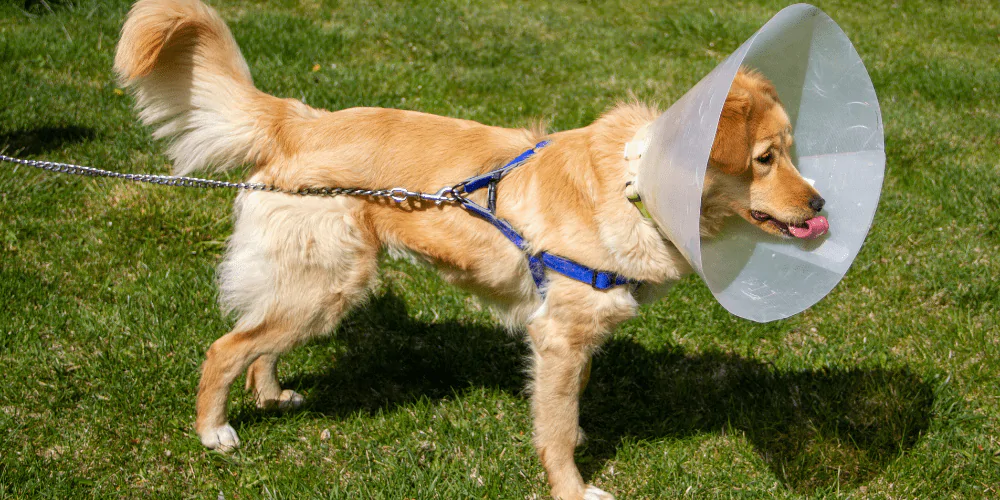
- Stop her licking her stitches or wounds. This can potentially cause infection and delay her recovery
You might find it best to use an Elizabethan collar (the cone), doughnut collar or protective vest to stop her from reaching her stitches.
Finally, be sure to give her plenty of gentle cuddles and reassurance after the operation.
How long will it take my dog to recover from being spayed?
You’ll usually be asked to bring her in three days post-surgery for a check-up. If a surgical glue was used, there’ll be another visit needed after 10 days. Usually her stitches will be removed about 10-14 days after the op.
Your vet will advise you on this, but you can usually start building up her fitness from 10 days after the surgery.
Bear in mind that recovery time might be affected if your dog is able to get at her stitches, or if she’s too active following the operation.
At what age should I spay my female dog?
The short answer: as close to her next season as possible.
It used to be the case that vets would recommend spaying before your dog’s first season, or alternatively time it for 12 weeks after their season ends. But behaviourists warn against this, because it’s possible to cause lifelong problems with a mistimed spay.
And it’s best for your dog to have at least one season, as having hormones through her adolescence will help her grow and mature properly.
So the current approach is to try to spay as close to next season as you can. And this should be timed at least three months (preferably four) from the end of her last season. It can be tricky to time this though, especially if you haven’t become familiar with your dog’s heat cycle and frequency.
Our expert says…
Certified clinical biologist Dr Caroline Warnes MRCVS has performed pioneering research into pseudopregnancy. Her advice is that it’s best for most dogs to have at least one season. This is particularly the case if:
- They’re a larger breed
- They’re an active performance dog, taking part in activities such as agility and flyball
- They’re prone to problems with their urinary tract and incontinence
- They’re prone to osteosarcoma (a form of bone cancer) and problems with their joints
- They have vaginal dermatitis or a recessed vulva
If a dog has her first season, this allows her joints to and vulva to develop properly.
On the other hand, you should only consider spaying before her first season if:
- They live with another female dog of similar age or breed
- There’s signs of tension with another female she lives with
These are potential issues because, during a season, the higher hormone levels can lead to increased aggression. It’s possible for spaying to curb the hormone flares in these cases. But be aware that this isn’t guaranteed.

At what time in her cycle should a female dog be spayed?
As mentioned, becoming familiar with your dog’s heat cycle is a good indicator here. When you get a better handle on how regularly your dog comes into season, you’ll have an idea when her next one will be. This will help with timing her spay appropriately.
On the other hand, if she’s coming up to her season or in season, the area will be engorged with blood and her blood vessels will swell. This will complicate any surgery.
Plus you should never spay a dog having a phantom pregnancy. If she’s showing any physical or behavioural signs, definitely avoid spaying her. Otherwise they can become locked into a cycle, which can cause enormous behavioural issues.
If a female dog has strong behavioural changes due to false pregnancy, Dr Caroline Warnes stresses the importance of spaying at the right time. You might need to medicate your dog, and spay only after the phantom pregnancy is completely finished.
Bear in mind that your dog may still show signs of phantom pregnancy some days after being spayed. This is due to her hormonal flow being interrupted, but it will pass.

If my dog is spayed at the wrong time, what behavioural problems can this cause?
If your dog’s in the middle of a phantom pregnancy, getting her spayed is definitely best avoided. Otherwise she could get locked into that physical and emotional state.
If the phantom pregnancy hasn’t ended when she’s spayed, it can lead to the following:
- Anxiety
- Depression
- Aggression, such as with other females
- Resource guarding
- Other physical problems
Concerned that your dog has gone through a mistimed spaying? If they’re showing new or increased behavioural problems, get in touch with a dog behaviourist.
It’s likely that your dog will need medication too, which they can take for up to three years after the operation.
Philippa Short is a certified dog trainer and behaviourist.
Another way to protect your female dog through adolescence is with peace-of-mind Petgevity dog insurance.

